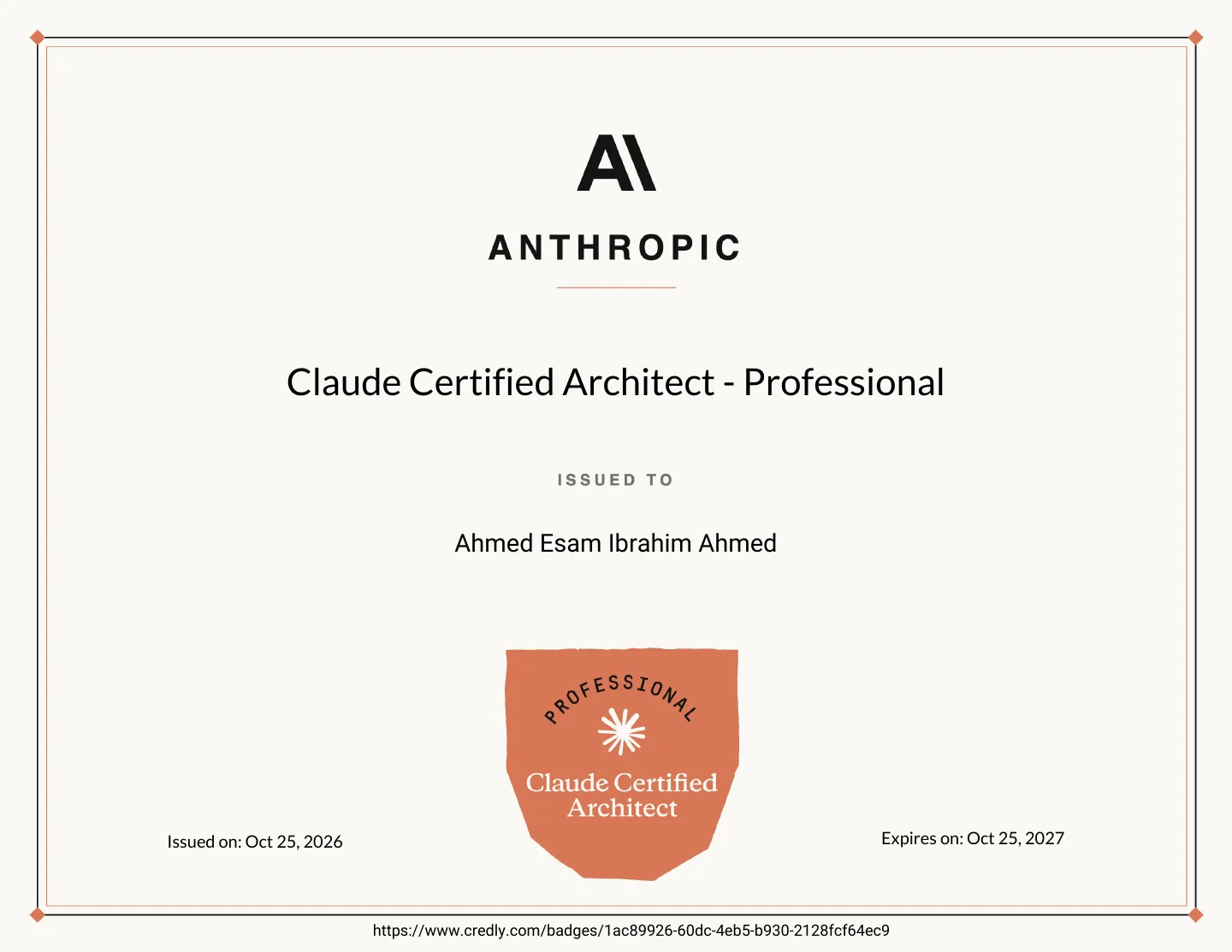
I passed the Claude Certified Architect exam. Here is my study guide, free.
I passed the Claude Certified Architect, Professional exam in October 2026. This guide grew out of the study sheet I wrote for myself: 95 cards and 124 practice questions.
- The guide is free and needs no sign-up: 95 cards across the 7 exam domains, 124 practice questions with explained answers, a pacing plan and a last 10 minutes list. Open the study guide.
- The exam: 63 items in 120 minutes, a scaled pass mark of 720, closed book and proctored.
- The official sample questions are short scenarios: the guide shows how to pick between 2 answers that both look reasonable.
- How I used it: I read my sheet end to end twice and used the practice questions the evening before.
01What the exam is
The Claude Certified Architect, Professional exam is Anthropic’s certification for people who design solutions with Claude. It has 63 items and you get 120 minutes, so about 2 minutes per item. Items are multiple choice with 1 answer, or multiple response, where the item tells you how many answers to pick. The pass mark is a scaled 720 on a scale of 100 to 1,000, and only the total counts. You sit it proctored and closed book.
The questions cover 7 domains with these weights:
| Domain | Weight |
|---|---|
| Integration | 19% |
| Solution design and architecture | 17% |
| Evaluation, testing and optimization | 16% |
| Governance, safety and risk management | 14% |
| Stakeholder communication and lifecycle management | 14% |
| Claude models, prompting and context engineering | 13% |
| Developer productivity and operational enablement | 7% |
One date matters: the exam content changes on 7 December 2026, and the updated exam guide comes out on 17 November 2026. This guide is written for the current version, so if you sit the exam on or after 7 December, prepare with the updated official guide.
02How I prepared
In the weeks before the exam I wrote a study sheet for myself. I read it end to end twice and used the practice questions the evening before the exam.
The official sample questions are short business scenarios, and often 2 answers look reasonable. The guide has a section on reading a question: the better answer usually removes the cause and respects every constraint the question states, such as a budget, a latency target or a regulation.
03What is in the guide
The public guide grew out of that sheet, rewritten for anyone preparing, on 1 page:
- 95 cards in 7 domains. Each explains 1 idea in plain English, then lists the facts to remember, the wording that gives the answer away, and the trap: the option that looks right and why it fails.
- 124 practice questions, all written for the guide. 103 are multiple choice: tap an option to see if it is right, then read why each wrong option fails. 21 are matching exercises.
- The exam outline first: the format and a pacing plan, then straight into the 7 domains.
- After the domains: how to read a question, 10 rules that answer most questions, the common traps, a last 10 minutes list of wording and the answer it points to, a glossary, and the courses and practice questions I studied from.
It has search, works on the phone, and prints with every answer open. Facts about Claude are as of October 2026.
043 of the guide’s 10 rules
Use the simplest pattern that works. A single call beats a workflow, a workflow beats an agent, and 1 agent beats several, unless the requirement forces the next step up.
Security lives in code, not in the prompt. Access limits belong in credentials, permissions and filters. A rule in the prompt is guidance the model can miss.
Measure before you decide. An evaluation set, metrics and agreed thresholds beat anecdotes and gut feeling.
The other 7 rules and all the traps are in the guide. Good luck with the exam.